
For many people deciding where to learn Spanish, one question comes up again and again: which variety of Spanish is the most neutral?
Spanish is spoken by more than 500 million people across 20 countries (21 if we count the US/Puerto Rico) on multiple continents, and no single version can be considered truly “standard” in a global sense. That said, some national and regional varieties are widely perceived as clearer, more consistent, and easier for learners to understand. Peruvian Spanish, particularly as spoken in certain regions of the country, is often cited as one of them.
This article explores why Peruvian Spanish is frequently described as neutral, what that actually means from a linguistic perspective, and where this generalization holds true and where it breaks down. It also places Peruvian Spanish in a wider context, comparing it to other varieties often considered accessible for learners.
What Does “Neutral Spanish” Actually Mean?
Before looking at Peruvian Spanish specifically, it is important to clarify what people usually mean by “neutral Spanish”.
In linguistic terms, neutrality does not imply correctness or superiority. Instead, it usually refers to a combination of features that make a variety of Spanish easier for non native speakers and learners to process. These features often include:
- Clear vowel pronunciation with minimal reduction
- Relatively slow or measured speech patterns
- Limited use of region specific slang or pronunciation
- Less phonetic reduction, such as dropping consonants like the final “s” of words
- Grammar that closely aligns with forms taught in formal instruction
Academic linguists would describe many of these features as conservative or standardized rather than neutral. The perception of neutrality is also strongly influenced by education systems, media exposure, and the varieties used in language teaching materials as well as an anglo-centric view of what constitutes “easy to understand.”
Institutions such as the Instituto Cervantes emphasize that all Spanish varieties are equally valid, but they also acknowledge that certain dialects are sometimes easier to understand for learners at earlier stages.
The Linguistic Landscape of Peru
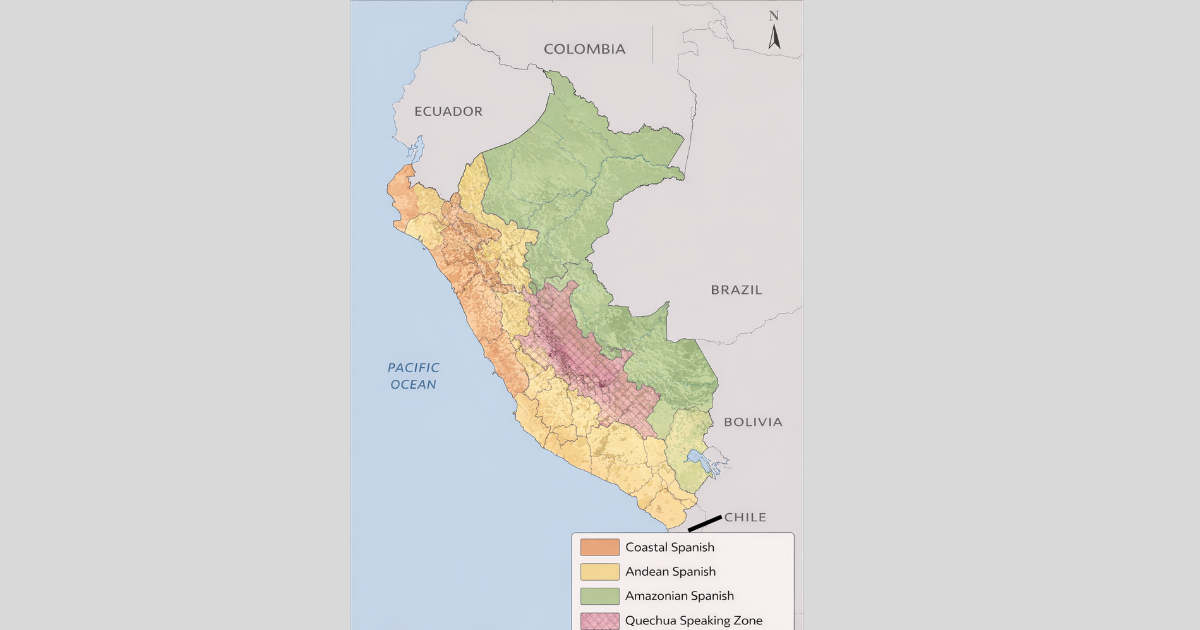
Peru is linguistically complex. While Spanish is the dominant language, it coexists with Indigenous languages such as Quechua and Aymara, which have influenced pronunciation, rhythm, and vocabulary across different regions.
Broadly speaking, linguists tend to distinguish between three major Spanish speaking regions in Peru:
- Coastal Spanish, such as that spoken in Lima
- Andean Spanish, spoken in highland cities such as Cusco
- Amazonian Spanish, spoken in eastern regions
When people refer to Peruvian Spanish as neutral, they are usually thinking of educated urban Spanish spoken in the Andes or in Lima, rather than all Peruvian Spanish uniformly.
Acknowledging this distinction is important, because the idea of neutrality applies unevenly across the country and ignores the complex and diverse cultural and linguistic tapestry of Peru.
Pronunciation and Phonetic Clarity
One of the strongest reasons Peruvian Spanish is perceived as neutral, is its pronunciation.
In much of Peru, Spanish is spoken with:
- Clear articulation of consonants
- Full pronunciation of final syllables
- Minimal aspiration or dropping of the letter “s”
- Consistent vowel sounds
This contrasts with varieties such as Caribbean Spanish, where syllable reduction and consonant weakening are common, or Rioplatense Spanish in Argentina and Uruguay, where intonation patterns and pronunciation of “ll” and “y” differ significantly from what learners are often taught.
From a phonetic perspective, Peruvian Spanish tends to preserve sounds in ways that closely match formal descriptions found in grammar books and beginner courses. This makes it easier for learners to connect spoken language with written forms.
Linguistic studies on Andean Spanish often note its relatively conservative phonology, particularly among speakers who are bilingual in Spanish and Indigenous languages, where clear articulation carries communicative importance.
Speech Rhythm and Intonation
Another factor contributing to perceptions of neutrality is rhythm.
Peruvian Spanish, especially in the Andes, is often spoken at a slower pace than Spanish in countries such as Spain, Chile, or parts of Mexico and the Caribbean. Intonation tends to be flatter, with fewer dramatic rises and falls.
For learners, this has practical consequences:
- Words are easier to segment
- Sentence boundaries are clearer
- Listening comprehension improves more quickly
This does not mean that Peruvians always speak slowly, nor that fast speech does not exist. It does mean that the baseline rhythm learners encounter, particularly in educational contexts, is often more accessible.
Research in second language acquisition consistently shows that reduced speech rate and clear intonation significantly aid comprehension in early and intermediate stages.
Grammar and Standard Usage

Peruvian Spanish is also often described as grammatically “clean”, though this term should be used cautiously.
What learners usually experience is:
- Consistent use of standard verb conjugations as per the Diccionario de la lengua española published by the Real Academia Española
- Limited use of voseo, which can complicate learning elsewhere
- Less frequent use of highly local grammatical constructions
This does not mean that Peruvian Spanish lacks colloquial or informal grammar. Like all living languages, it includes regional expressions and informal speech. However, in educational and professional settings, standard forms tend to dominate.
This aligns closely with the Spanish taught in many international courses, learning apps and textbooks, which often draw implicitly on perceived Latin American norms that most closely match the Spanish spoken in one of Mexico, Colombia or Peru.
Vocabulary and Lexical Accessibility
Peruvian Spanish contains regional vocabulary, particularly terms influenced by Quechua. However, compared to some other regions, local slang is often used more selectively, especially with non native speakers.
In practice, learners in Peru often report that:
- Standard vocabulary is widely understood and used
- Regionalisms are easy to identify and explain
- Speakers adapt their language readily for clarity
This adaptive behaviour is sociolinguistically significant. Peru has a long tradition of multilingualism and language contact, which has shaped communicative norms around clarity and accommodation. The popularity of foreign media, which is often dubbed with Mexican Spanish, as well as the cultural influence of Argentina results in most Peruvians being familiar with a wide-variety of country-specific slang and speech patterns.
Historical and Social Reasons Behind Peru’s “Neutral” Spanish

History
While the “neutral” label is always relative and subjective, there are concrete historical and sociolinguistic reasons why Spanish in Peru, especially in the central Andean region and in cities such as Lima and Cusco, developed in ways that differ from Spanish elsewhere in the Americas.
One key factor is the nature of Spanish colonisation in Peru. Unlike many Caribbean and coastal regions, where Spanish settlement was early, intensive, and heavily influenced by Andalusian and Canary Island Spanish, Peru’s colonial administration was more bureaucratic and centralized. Lima became the seat of the Viceroyalty of Peru in the sixteenth century, functioning as an administrative and judicial centre rather than a port driven primarily by trade and migration. This helped preserve a more conservative variety of Spanish, closer to peninsular norms of the time, with less rapid phonetic erosion.
Another crucial element is sustained contact with Indigenous languages, particularly Quechua and Aymara. Rather than replacing these languages quickly, as occurred in some parts of Latin America,, Spanish coexisted with them for centuries, often as a second language used in formal, religious, or administrative contexts. This prolonged bilingualism shaped Spanish pronunciation and rhythm. Linguists have frequently noted that contact with Quechua, a language with a relatively regular syllable structure and no consonant reduction at word endings, encouraged clearer articulation in Spanish and reduced phenomena such as syllable dropping or consonant aspiration that are common in Caribbean and coastal varieties.
Geography
Geography also played an important role. Peru’s mountainous terrain limited internal mobility for long periods, slowing linguistic change and reducing the spread of fast evolving urban slang or phonetic shifts. In contrast, countries with flatter terrain and stronger coastal trade networks experienced greater mixing of dialects, faster innovation, and more pronounced regional variation.
Social
Finally, social attitudes toward language have mattered. In Peru, particularly in educational and institutional contexts, there has historically been a strong emphasis on clarity, correctness, and formality in Spanish. While this has sometimes been tied to social hierarchies and exclusion, it has also reinforced speech patterns characterised by careful pronunciation and a slower pace.
Taken together, these factors help explain why many learners perceive Peruvian Spanish as neutral or easier to understand. This does not mean it is uniform, static, or free of regional variation. Rather, it reflects a specific historical trajectory shaped by colonial administration, Indigenous language contact, geography, and social norms around speech.
How Peruvian Spanish Compares to Other “Neutral” Varieties
Peruvian Spanish is not the only variety often described as neutral.
Others frequently mentioned include:
- Standard Mexican Spanish, particularly from central regions
- Colombian Spanish from Bogotá
- Ecuadorian Spanish from the highlands
Each of these shares some features with Peruvian Spanish, such as clear pronunciation and relatively standard grammar.
The choice between them often comes down to regional exposure, personal preference, and learning context rather than objective superiority.
Linguists generally agree that no accent is inherently easier, but some are considered easier for learners at particular stages.
Where the Idea of Neutrality Falls Short
It is important to stress that “neutral Spanish” is a perception, not a scientific classification.
Some limitations of this idea include:
- It often centres educated urban speech and marginalises other varieties
- It can oversimplify complex linguistic realities
- It may change depending on the learner’s native language
For example, learners from tonal or syllable timed languages may perceive rhythm differently than English speakers. Others may find exposure to faster or more varied accents beneficial earlier on.
Additionally, Spanish spoken in Peru varies significantly by region, age, and social context. A single label cannot capture this diversity.
Why Peru Remains Attractive for Spanish Learners
Despite these caveats, Peru continues to attract Spanish learners of all levels for reasons that go beyond linguistics alone.
These include:
- A strong tradition of language education
- Cultural emphasis on clear communication
- Opportunities for immersive, real world use of Spanish
- Exposure to both standard and regional varieties
For learners interested in building a strong foundation before encountering wider variation, this environment can be particularly supportive.
A Final Perspective
Peruvian Spanish is often considered neutral because it combines clear pronunciation, accessible rhythm, and relatively standard grammatical usage, especially in Andean and urban contexts. This perception is widely shared but not universally agreed upon, and it should be understood as a practical observation rather than an absolute truth.
Ultimately, the best place to learn Spanish depends on individual goals, learning style, and personal interest. Peru offers one compelling option among several, distinguished by its linguistic clarity and cultural richness.
If you are interested in a Spanish immersion experience in Peru, Proyecto Peru Centre offers Spanish immersion programs as well as online Spanish courses designed to support learners at different levels while engaging with the country’s diverse linguistic and cultural landscape.
2 thoughts on “Why Is Peruvian Spanish Considered So Neutral?”
Comments are closed.